
A standard cigarette carton contains 10 packs of cigarettes. Each pack holds 20 cigarettes, which means every carton contains a total of 200 cigarettes. This standard applies across the United States and most international markets regardless of brand variation.
However, cigarette cartons are also available in alternative configurations:
|
Carton Type |
Packs Per Carton |
Cigarettes Per Pack | Total Cigarettes |
| Standard Carton | 10 | 20 | 200 |
| Half Carton | 5 | 20 | 100 |
| Large Carton | 20 | 20 | 400 |
| Australian Variant | 10 | 25 | 250 |
Because a cigarette carton is designed to hold 10 packs arranged in a 2x5 configuration, its physical dimensions, weight, and shipping specifications are all determined by this foundational structure. This is why understanding pack quantity is essential for anyone involved in cigarette packaging, wholesale distribution, or custom carton manufacturing.
Why 10 Packs Is the Industry Standard
The 10-pack standard is not arbitrary. It exists because of multiple converging factors across manufacturing, retail, and logistics systems.
Retail Display Optimization:
Cigarette cartons are structured to fit standard retail shelving units and behind-counter display systems. A 10-pack carton provides the ideal balance between product visibility and space efficiency. Retail-ready cigarette carton packaging must align with store display dimensions to maximize shelf presence without wasting valuable retail space.
Inventory Efficiency:
For retailers and wholesale distributors, the 10-pack standard simplifies inventory tracking. When every carton contains exactly 10 packs, stock counting becomes straightforward. If a retailer has 50 cartons, they know immediately that they hold 500 packs or 10,000 cigarettes without complex calculations.
Manufacturing Standardization:
Cigarette carton manufacturers rely on consistent pack quantities to standardize die-line designs, printing templates, and production workflows. Changing the pack count would require entirely new structural blueprints, increasing production costs and lead times.
Cost Bundling:
The 10-pack configuration creates an optimal price point for bulk purchasing. It offers enough quantity to justify a volume discount while remaining affordable for individual consumers.
Shipping Efficiency:
Cigarette cartons are configured for efficient palletization. The 10-pack structure creates uniform carton dimensions that stack predictably inside master cases and onto shipping pallets, reducing wasted space and transportation costs.
Standard Cigarette Carton Dimensions & Structural Specifications
Because a cigarette carton holds 10 packs in a 2x5 layout, its dimensions are directly influenced by the size of cigarettes inside each pack. According to the US Centers for Disease Control and Prevention (CDC), cigarettes fall into four size categories:
|
Cigarette Type |
Length (mm) | Diameter (mm) |
| Regular Unfiltered | 68–70 | 7.5–8.0 |
| King-Size Filtered | 79–88 | 7.5–8.0 |
| Filtered Longs | 94–101 | 7.5–8.0 |
| Extra-Long | 110–121 | 7.5–8.0 |
| Slim Varieties | Various | 5.0–6.0 |
These cigarette dimensions determine the pack size, which in turn determines the carton dimensions.
Standard Carton Specifications:
|
Specification |
Value |
| Typical Length | 200–220 mm |
| Typical Width | 85–95 mm |
| Typical Height | 80–90 mm |
| Board Thickness | 250–350 GSM |
| Typical Weight (empty) | 80–120 grams |
| Typical Weight (full) | 350–450 grams |
| Internal Configuration | 2 rows × 5 packs |
Cigarette cartons are structured with precise tolerances to ensure packs fit securely without movement during shipping. Even a few millimeters of excess internal space can cause pack shifting, leading to product damage and customer complaints. This is why custom cigarette carton manufacturers invest heavily in accurate die-line design and structural testing.
Cigarette Carton Material Types & Board Specifications
The material used to manufacture cigarette cartons directly impacts product protection, print quality, brand perception, and shipping durability. Cigarette cartons are manufactured using two primary material categories:
Paperboard (SBS — Solid Bleached Sulfate)
This is the most common material for cigarette carton packaging. It offers:
- Smooth surface for high-quality printing
- Excellent color reproduction for branding
- Lightweight yet sturdy structure
- Ideal for retail display cartons
- Available in 250–350 GSM range
- Supports embossing, foil stamping, and UV coating
Corrugated Board
Used primarily for:
- Master case packaging (outer shipping boxes)
- Wholesale distribution cartons
- Heavy-duty protection during long-distance shipping
- Available in single-wall and double-wall configurations
Specialty & Eco-Friendly Materials
For brands focused on sustainability, cigarette cartons are also manufactured using:
- FSC-Certified Paperboard — sourced from responsibly managed forests
- Recycled Paperboard — made from post-consumer waste
- Biodegradable Coatings — replacing traditional plastic lamination
- Soy-Based & Eco-Friendly Inks — reducing chemical footprint
The choice of material influences not just protection but also the perceived value of the brand. Premium cigarette brands often use higher GSM paperboard with luxury finishes like soft-touch lamination, metallic foil, and spot UV to create a premium unboxing experience.
Types of Cigarette Carton Packaging
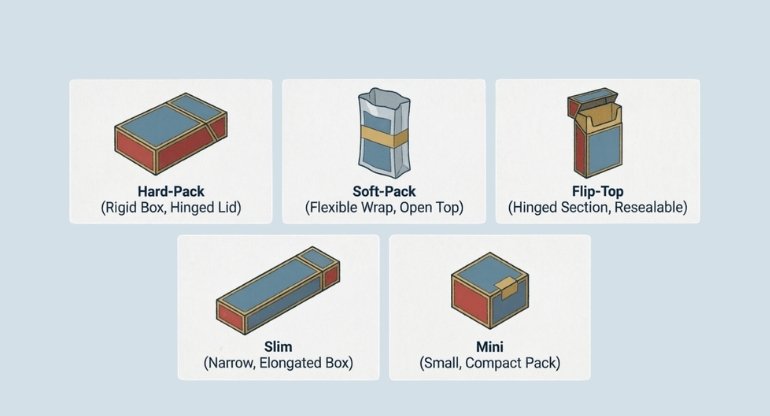
Cigarette cartons are available in multiple types based on structural design, size configuration, and intended use. Understanding these variations is essential for manufacturers, retailers, and wholesale distributors.
By Structural Design
Hard-Pack Cartons:
These are manufactured using rigid paperboard that provides maximum protection against crushing during shipping, storage, and retail display. Hard-pack cartons are the most popular choice for premium cigarette brands because they maintain structural integrity and enhance brand presentation.
Soft-Pack Cartons:
Soft-pack cartons are made from thinner, more flexible paper stock. They are lightweight, cost-effective, and easier to carry. However, they offer less protection compared to hard-pack cartons and are more susceptible to crushing.
Flip-Top Cartons:
Flip-top cigarette carton packaging features a hinged lid that opens upward for easy access to cigarette packs. This design provides better arrangement, improved product presentation, and convenient dispensing for retailers.
By Size Configuration
|
Carton Type |
Pack Count | Cigarettes Per Pack | Total | Best For |
| Standard | 10 | 20 | 200 | General retail & wholesale |
| Slim | 10 | 20 (slim) | 200 | Ultra-slim cigarette brands |
| Mini | 5 | 20 | 100 | Travel retail & sampling |
| Large | 20 | 20 | 400 | Bulk wholesale & duty-free |
By Brand & Flavor Segmentation
All major cigarette brands offer cartons with standard tobacco configuration. However, they also produce separate carton packaging for:
- Menthol cigarettes
- Flavored varieties (cherry, clove, vanilla)
- Premium lines with luxury packaging
- Limited edition seasonal releases
These specialty cartons often feature unique printing, finishing, and structural design to differentiate them on retail shelves.
By Market & Regional Variation
Cigarette cartons are configured differently according to country-specific regulations and market demands:
- United States: 10 packs × 20 cigarettes = 200 total
- Australia: 10 packs × 25–26 cigarettes = 250–260 total
- Europe: Varies by country (plain packaging laws in some regions)
- Duty-Free Markets: Often 20-pack cartons (400 cigarettes)
By Promotional & Seasonal Purpose
Cigarette brands frequently modify carton configurations for:
- Promotional campaigns — adding an extra pack to attract customers
- Seasonal offers — holiday-themed packaging with special finishes
- Discount bundles — larger cartons with reduced per-pack pricing
- Limited editions — collector-style packaging with unique designs
These promotional cigarette cartons serve as powerful marketing tools that drive brand visibility and customer engagement.
Custom Cigarette Carton Printing & Branding
For cigarette brands looking to differentiate themselves in a competitive market, custom cigarette carton packaging offers extensive branding opportunities. Cigarette cartons are designed to serve as both protective packaging and powerful brand communication tools.
Custom Sizing & Die-Line Design
Every cigarette carton begins with a die-line — the structural blueprint that defines:
- Exact dimensions based on cigarette size and pack count
- Fold lines and glue flaps
- Tuck-in or flip-top closure mechanism
- Internal divider placement for pack arrangement
Custom die-line design ensures that every carton is manufactured to precise specifications, eliminating wasted material and ensuring a perfect fit for the packs inside.
Printing Methods
|
Method |
Best For | Quality Level |
| Offset Lithography | Large production runs | Highest color accuracy |
| Digital Printing | Short runs & prototyping | Good quality, fast turnaround |
| Flexographic | High-volume wholesale | Cost-effective |
Premium Finishing Options
Custom cigarette cartons can be enhanced with:
- Embossing & Debossing — raised or pressed texture for tactile brand elements
- Foil Stamping — metallic gold, silver, or holographic accents
- Spot UV Coating — glossy highlights on specific design elements
- Matte vs Gloss Lamination — full-surface protection and visual appeal
- Soft-Touch Lamination — velvety texture for luxury positioning
- Holographic Effects — security feature and premium aesthetics
MOQ & Production Lead Time
| Factor | Typical Range |
| Minimum Order Quantity (MOQ) | 500–5,000 cartons |
| Production Lead Time | 7–15 business days |
| Prototype/Sample Time | 3–5 business days |
| Design Revision Rounds | 2–3 included |
Custom cigarette carton printing transforms standard packaging into a brand asset that influences consumer perception and purchase decisions at the point of sale.
Wholesale & Bulk Cigarette Carton Packaging
For wholesale distributors, understanding cigarette carton packaging at scale is critical for efficient operations. Wholesale cigarette packaging involves multiple layers of packaging beyond the individual carton.
Master Case Packaging
A master case is the outer shipping container that holds multiple cigarette cartons. Standard configurations include:
|
Configuration |
Details |
| Cartons per Master Case | 25–50 cartons |
| Packs per Master Case | 250–500 packs |
| Total Cigarettes per Case | 5,000–10,000 |
| Case Material | Corrugated cardboard |
| Case Weight (full) | 8–18 kg |
Storage Requirements
- Cigarette cartons must comply with specific storage conditions to maintain product quality:
- Temperature: 15–25°C (59–77°F)
- Humidity: 55–65% relative humidity
- Light Exposure: Minimal (UV degrades packaging print)
- Ventilation: Adequate airflow to prevent moisture buildup
- Stacking: Maximum 5–6 master cases high
Shipping Weight Calculation
For logistics planning, here's a quick calculation framework:
- 1 Carton = 10 Packs = 200 Cigarettes ≈ 400g
- 1 Master Case = 50 Cartons = 500 Packs ≈ 20kg
- 1 Pallet = 60 Cases = 3,000 Cartons ≈ 1,200kg
Knowing these figures helps wholesale distributors calculate freight costs, warehouse space requirements, and reorder points accurately.
Regulatory & Labeling Requirements for Cigarette Cartons
Cigarette cartons must comply with strict regulatory requirements that vary by country and jurisdiction. Understanding these requirements is essential for any cigarette packaging manufacturer.
Health Warning Placement
Most countries require prominent health warnings on cigarette packaging:
- United States: Text warnings covering 50% of top front and rear panels
- Australia: Plain packaging with 75% graphic health warnings
- European Union: 65% of front and back surfaces
- Canada: 75% of principal display surfaces
Tax Stamp Placement
Tax stamps or excise marks must be placed on specific areas of the carton:
- Typically on the cellophane overwrap or directly on the carton
- Position varies by state/country regulations
- Must be visible without opening the carton
- Tamper-evident placement required
FDA Packaging Compliance (United States)
For US market cigarette cartons, the FDA requires:
- Specific health warning rotation
- Ingredient disclosure
- Nicotine content labeling
- No misleading descriptors (e.g., "light," "mild")
- Compliance with Family Smoking Prevention and Tobacco Control Act
Plain Packaging Laws
Several countries have implemented plain packaging regulations:
- Australia (since 2012) — first country to implement
- United Kingdom (since 2017)
- France (since 2017)
- New Zealand, Ireland, Norway — also adopted
Under plain packaging laws, cigarette cartons must use standardized colors, fonts, and layouts with no brand-distinctive design elements.
Does Carton Size Affect Cigarette Consumption?
According to a study conducted by the University of Bristol and published in the Journal of Addiction, packaging quantity does influence consumption behavior.
The study found that when participants received packs containing 25 cigarettes instead of the standard 20, their daily consumption increased by 1.3%. This suggests that larger packaging formats can subtly encourage higher usage.
Key Findings:
|
Pack Size |
Daily Consumption Impact |
| 20 cigarettes (standard) | Baseline |
| 25 cigarettes | +1.3% increase |
This research has implications for:
- Public health policy — supporting smaller pack regulations
- Packaging strategy — understanding how carton size influences buying behavior
- Retail planning — balancing bulk discounts with responsible selling practices
From a packaging manufacturer's perspective, this data reinforces the importance of understanding how cigarette carton configuration impacts not just logistics but also consumer behavior and regulatory compliance.
Advantages of Buying & Using Cigarette Cartons
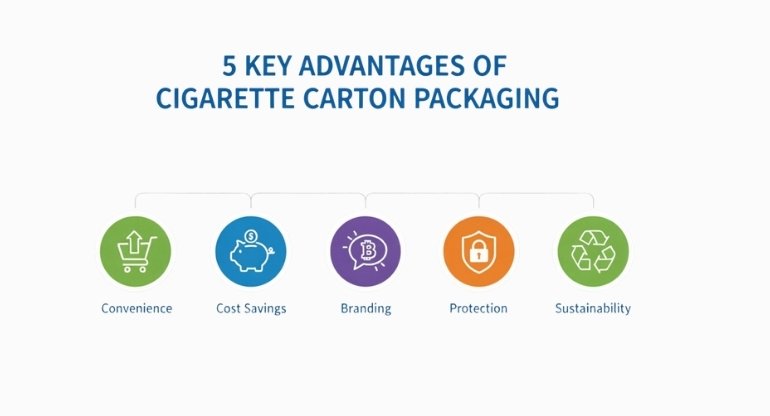
Whether you are a retailer, wholesale distributor, or manufacturer, cigarette cartons offer clear operational and commercial benefits.
1. Convenience & Organization
Cigarette cartons are configured for efficient retail display and storage. The 10-pack structure keeps products organized, prevents individual packs from falling or getting misplaced, and allows wholesale suppliers to transport larger quantities efficiently.
For consumers, purchasing a full carton eliminates the need for frequent store visits, providing a convenient bulk buying solution.
2. Cost Savings
Buying cigarettes by the carton is significantly more cost-effective than purchasing individual packs. Retailers typically offer per-pack discounts on carton purchases, making them attractive for regular smokers looking to save money.
From a manufacturing perspective, producing cartons in bulk reduces per-unit costs through economies of scale in printing, material procurement, and shipping.
3. Brand Communication
Printed cigarette carton boxes serve as powerful branding vehicles. They provide ample surface area for:
- Brand logos and visual identity
- Product information and differentiation
- Health warnings (regulatory compliance)
- Premium finishes that enhance perceived value
Custom cigarette carton packaging transforms a functional container into a brand asset that communicates quality, heritage, and market positioning.
4. Product Protection
Hard-pack cigarette cartons protect cigarettes from:
- Physical crushing during shipping and handling
- Moisture damage during storage
- UV degradation from light exposure
- Contamination from environmental factors
This protection maintains product freshness and quality from manufacturing facility to consumer.
5. Environmental Responsibility
Modern cigarette cartons are manufactured using increasingly sustainable materials:
- Recyclable paperboard reduces landfill waste
- FSC-certified materials ensure responsible forestry
- Biodegradable coatings replace plastic lamination
- Eco-friendly inks minimize chemical impact
For brands committed to sustainability, eco-friendly cigarette carton packaging demonstrates environmental responsibility while meeting growing consumer demand for green products.
Benefits of Knowing Pack Count for Business Operations
Understanding the exact number of packs in a cigarette carton brings tangible operational advantages for retailers, distributors, and manufacturers.
Inventory Management
Knowing that every standard carton contains exactly 10 packs allows for precise inventory tracking. Retailers can calculate total stock by simply counting cartons rather than individual packs, reducing counting errors and saving time during stock audits.
Quick Inventory Formula:
Total Packs = Number of Cartons × 10
Total Cigarettes = Number of Cartons × 200
Accurate Ordering & Restocking
Precise pack-count knowledge eliminates guesswork when placing orders. Retailers can calculate exact reorder quantities based on sales velocity, preventing both understocking (lost sales) and overstocking (tied-up capital).
Shipping & Logistics Efficiency
When processing bulk orders, knowing the carton-to-pack ratio enables instant shipping calculations:
- 200 packs ordered = 20 cartons to ship
- 500 packs ordered = 50 cartons = 1 master case
- 5,000 packs ordered = 500 cartons = 10 master cases
This eliminates counting errors and accelerates order fulfillment.
Pricing & Profit Margin Calculation
Understanding pack quantity per carton is fundamental for pricing strategy:
Cost per Pack = Carton Wholesale Price ÷ 10
Retail Markup = (Retail Price per Pack - Cost per Pack) × 10
Profit per Carton = Retail Markup × Number of Cartons Sold
This knowledge helps retailers set competitive prices while maintaining healthy profit margins.
Conclusion
From custom cigarette carton printing to wholesale packaging, material selection, and regulatory labeling considerations, every element of carton packaging plays an important role in product protection, compliance, and brand presentation. Businesses across the USA and Canada work with experienced providers like Your Box Packaging to ensure their cartons meet both operational requirements and market standards.
If you are exploring reliable custom cigarette carton packaging solutions, partnering with a knowledgeable packaging manufacturer can help simplify the process. Competitive pricing, flexible order quantities, dependable turnaround times, and professional design support all contribute to efficient production and consistent quality. To learn more or discuss your project requirements, you can contact Your Box Packaging at sales@yourboxpackaging.com.